In Malaysia, we have a unique corporate sound. It isn’t the clicking of keyboards or the humming of the air conditioner. It is the sound of silence in a boardroom when the Big Boss asks, “Does anyone have any objections?”
Pin drop.
Then, ten minutes later, at the mamak stall downstairs, the real meeting happens. The complaints flow like Teh Tarik. The disagreements are loud. The passion is real.
Why does this happen? Why do we have two versions of the same team? One that is polite, compliant, and “dead” in the office, and one that is vibrant, opinionated, and “alive” outside of it?
In my 20 years as a Human Resource Development consultant, I have diagnosed this illness a thousand times. It is not a lack of talent. It is a lack of Psychological Safety. And the cure isn’t another boring KPI meeting. The cure is genuine, strategically designed Team Bonding.
The Asian “Face” Dilemma
In our culture, we value hierarchy. We respect our elders and our leaders. We operate on Jaga Muka (saving face) and Jaga Hati (sparing feelings). While these are beautiful societal values, they can be absolute poison in a high-performance team.
When a staff member sees a flaw in a plan but stays silent because they don’t want to “shame” the boss, that is not respect; that is an Emotional Block. In NLP (Neuro-Linguistic Programming) terms, the staff member is trapped in an unresourceful state. Their internal dialogue is screaming, “Safety first! Don’t rock the boat!”
This is where the Amygdala Hijack comes in. When the brain senses a threat—even a social threat, like looking stupid in front of a Dato’—the amygdala takes over. Creative thinking shuts down. Empathy shuts down. The only thing that works is the “Freeze” response.
Team bonding is the only controlled environment where we can safely hack this response.
Story from the Trenches: The “Perfect” Team That Failed
I remember consulting for a mid-sized manufacturing firm in Selangor about seven years ago. The CEO, let’s call him Mr. Lim, was a brilliant man. High IQ, sharp suit, very intimidating. He hired me because his team was “lacking initiative.”
”Abe,” he told me, “They agree with everything I say, but then the execution is terrible.”
I sat in on a meeting. Mr. Lim proposed a new, very risky marketing strategy. He looked around the table. “Any thoughts?”
His Sales Manager nodded. “Great idea, Boss.”
His Ops Manager smiled. “We can do it, Boss.”
His HR Manager wrote it down. “Noted, Boss.”
Using Sensory Acuity—the NLP skill of reading non-verbal cues—I looked at the Ops Manager. His mouth was smiling, but his feet were tucked tight under his chair (a sign of anxiety), and his blink rate had doubled. There was no Congruence between his words and his body.
The project went ahead. Six months later, it failed spectacularly, costing the company hundreds of thousands.
During our post-mortem team bonding session later that year, we played a game that removed titles. The Ops Manager finally admitted, “I knew the timeline was impossible. But I was scared to be the ‘negative’ one.”
That silence cost them a fortune. If they had invested in team bonding before the crisis to build Rapport and trust, that Ops Manager might have felt safe enough to say, “Boss, I love the vision, but the timeline scares me.”
Breaking the “Map”
One of the core presuppositions of NLP is: “The Map is not the Territory.”
Your reality (your Map) is not the absolute truth (the Territory). The CEO has a map that focuses on profit and vision. The Tea Lady has a map that focuses on morale and cleanliness. The Engineer has a map that focuses on risk and structure.
Disasters happen when we think our map is the only one.
Effective team bonding forces us to swap maps. When we do an activity like “The Blind Shepherd”—where the junior staff must guide a blindfolded manager—we are engaging in a powerful Perceptual Position shift. Suddenly, the boss feels the vulnerability of the staff. Suddenly, the staff feels the burden of leadership.
This creates Empathy—not just the cognitive kind (“I understand you”), but the emotional kind (“I feel you”).
From “Bodek” to Bonded
There is a difference between a team that likes each other and a team that trusts each other. You can like your colleagues and still not trust them with your weakness.
Real bonding moves a team up the Logical Levels of Change:
- Environment: We work in the same office. (Low bond)
- Behavior: We eat lunch together. (Medium bond)
- Values & Identity: “We are a tribe that has each other’s backs.” (High bond)
To get to that top level, we need to create Anchors. In my programs, I often use shared emotional experiences—laughter, struggle, or a “Eureka” moment—to create a positive anchor. Back in the office, when stress hits, someone can crack a joke referencing that shared memory, and immediately, the team’s state shifts from stressed to resourceful.
Story from the Trenches: The Bamboo Raft
I once took a team of highly competitive bankers to a river in Pahang. These were sharks. They would step over their own grandmother to get a promotion. Their culture was “Me vs. You.”
The task was simple: Build a bamboo raft and cross the river.
Naturally, the loudest “Alpha” males took charge. They shouted orders. They didn’t listen. They built a raft that looked impressive but had no structural integrity. It sank five meters from the shore.
Meanwhile, a quiet team led by a fierce, diminutive HR executive sat down first. They planned. She asked, “What is your strength?” to each member. She utilized the big guy for knots and the detail-oriented accountant for spacing.
They didn’t just cross the river; they stayed dry.
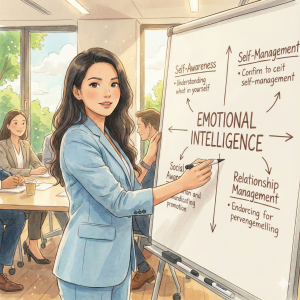
At the debrief, the Alpha bankers were humbled. We discussed EQ (Emotional Intelligence)—specifically Social Awareness and Relationship Management. The loud leaders realized that IQ (knowing how to build) was useless without EQ (knowing how to lead people to build).
The bond formed that day wasn’t because they swam in a river. It was because the hierarchy was flattened, and competence was redefined.
The ROI of “Not Me, But We”
Critics often say team bonding is a waste of money. “Why pay for them to play games?”
I tell them: You aren’t paying for games. You are paying for speed.
A team that trusts each other makes decisions faster. They don’t write “Cover Your Ass” emails. They don’t hold secret meetings at the mamak. They address the “Elephant in the Room” immediately.
When we strip away the titles, the ego, and the fear, we are left with the human potential. We move from a group of individuals protecting their own “Rice Bowl” to a unified force protecting the company’s future.
So, the next time you think team bonding is just “holding hands and singing,” remember: The most expensive thing in your business isn’t the software or the rental. It’s the silence of a team that doesn’t feel safe enough to tell you the truth.
Let’s break that silence. Let’s move from “Not Me” to “We.”