We live in a world that is obsessed with speed. We want faster internet, faster deliveries, and faster answers. We celebrate the sharpest minds, the quickest calculations, and the most efficient systems. Yet, in this race for efficiency, we often find ourselves stumbling over the one thing that truly matters: Connection.
Have you ever walked into a room and felt the tension before a single word was spoken? Or conversely, have you met someone who, within minutes, made you feel completely seen and heard?
This is not magic. It is not merely “charm.” It is the silent, powerful language of Emotional Intelligence (EQ).
For over two decades, I have walked the path of human development, observing the intricate dance of teams and leaders. I have learned that while your IQ—your cognitive intellect—might build the ship, it is your EQ that navigates it through the storm.
The Two Minds Within Us
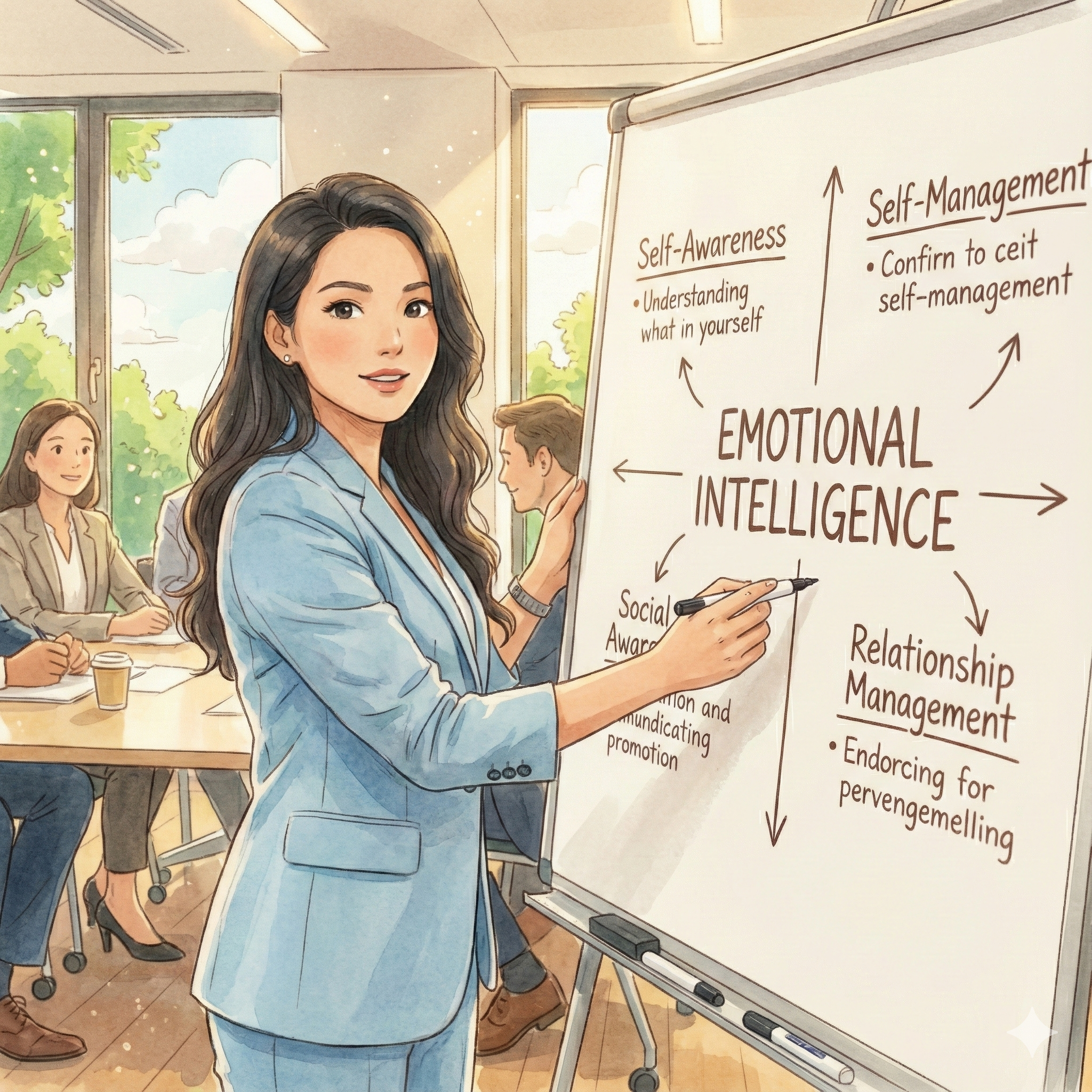
Ancient wisdom often speaks of the balance between the Head and the Heart. Modern psychology gave this a framework, most notably through the work of Daniel Goleman. He taught us that true intelligence is not just about data processing; it is about emotional processing.
To understand EQ is to understand the five pillars that hold up the temple of our character.
1. The Mirror (Self-Awareness)
True wisdom begins with the self. It is the ability to look in the mirror and see not just your face, but your state of being. It is the quiet realization that says, “I am feeling defensive right now because I am afraid of being wrong.” Without this mirror, we are strangers to ourselves, reacting blindly to the world.
2. The Anchor (Self-Regulation)
Emotions are like weather; they can be sunny one moment and stormy the next. We cannot stop the storm, but we can choose how we sail through it. Self-regulation is your anchor. It is the pause between the trigger and the reaction. It is the discipline that allows a leader to remain calm when chaos erupts, providing safety for everyone else.
3. The Inner Fire (Motivation)
There are two ways to move a donkey: a carrot or a stick. But humans are not beasts of burden. High EQ individuals are driven by an inner fire—a passion for growth, a desire to learn, and a commitment to excellence that requires no applause. They do not work just for the paycheck; they work for the purpose.
4. The Bridge (Empathy)
This is perhaps the most profound of all skills. Empathy is the ability to leave the fortress of your own perspective and walk across the bridge to another’s reality. It is listening not to reply, but to understand. When we cultivate empathy, we stop seeing colleagues as “resources” and start seeing them as human beings carrying their own invisible burdens.
5. The Harmony (Social Skills)
When the first four pillars are strong, the fifth emerges naturally. Social skill is not manipulation; it is the art of harmony. It is the ability to guide a group, to diffuse conflict with a gentle word, and to inspire others to move in the same direction. It is the difference between a group of individuals and a true team.
Why We Are Starving for EQ
In my years as a consultant, I have seen brilliant companies crumble—not because they lacked strategy, but because they lacked soul.
We often think that “soft skills” are optional. But consider this:
-
How much productivity is lost to unresolved grudges?
-
How many great ideas die because a team member was too afraid to speak up?
-
How many leaders burn out because they carry the weight of the world without knowing how to manage their own stress?
Logic makes us think, but emotion makes us act. If we ignore the emotional undercurrents of our workplace, we are captaining a ship with a leak in the hull. We might stay afloat for a while, but eventually, the water will rise.
The Journey Back to Each Other
The beautiful truth about Emotional Intelligence is that, unlike your IQ, it is not fixed. It is a path you can choose to walk at any age. It is a muscle that grows stronger with exercise.
Imagine a workplace where conflict is met with curiosity rather than aggression. Imagine a team that intuitively supports one another when the pressure mounts. Imagine a leadership style that doesn’t just demand results, but inspires loyalty.
This reality is possible. But it does not happen by accident. It requires intention. It requires a guide.
We spend a lifetime learning to read books, write reports, and calculate figures. But when was the last time we gathered together to learn how to read each other?
A Question for You
As you read this, think about your own team. Think about the silence in the meeting room, or the friction that slows down your projects.
Are you merely working next to each other, or are you truly connected?
There is a depth of potential in your people that you have not yet tapped into. It isn’t found in a spreadsheet. It is found in the messy, human, beautiful work of emotional connection.
I have spent twenty years mastering the art of unlocking this potential. I have seen skeptics turn into believers and fractured groups transform into families.
If you feel a stirring—a curiosity about what your team could become if they finally learned to speak this silent language—then perhaps it is time we sat down.
The journey to a wiser, stronger team begins with a single step. Are you ready to take it?